Preserving Food Value: Rethinking how the world understands food
There is a paradox we keep repeating.
We produce enough food to feed everyone. And yet, millions of people still go hungry… while enormous quantities of food are lost or wasted every single day.
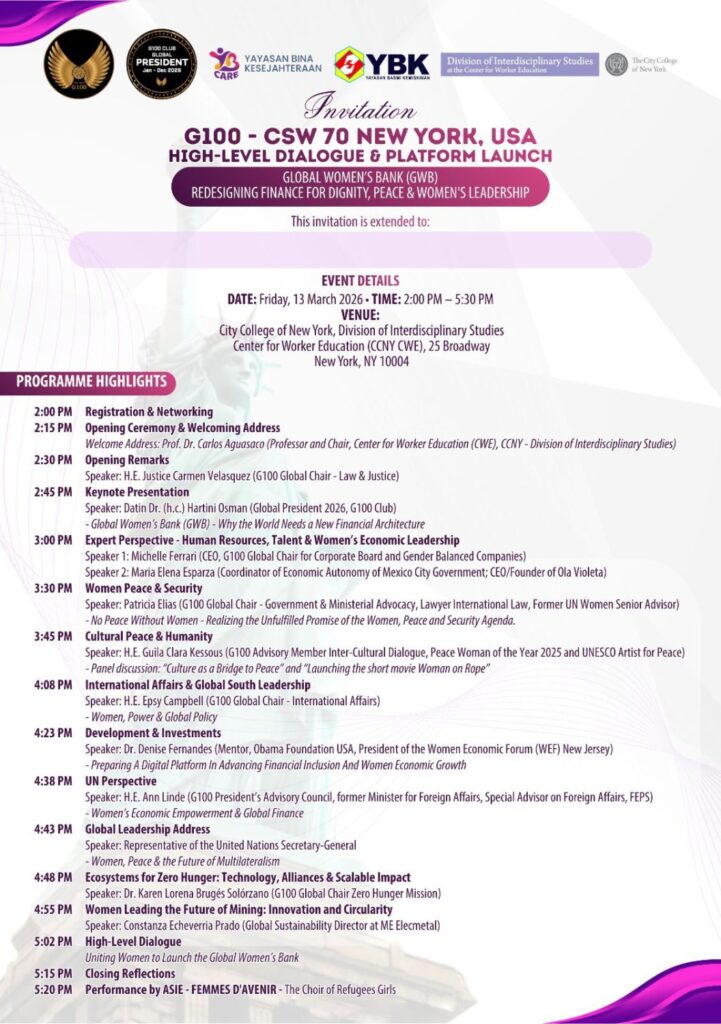
I shared this reflection recently during CSW70 in New York, in a high-level dialogue with global leaders from G100, across policy, finance, sustainability, and international cooperation.
It was not a small room. It was a room where decisions are shaped.
And what became clear to me in that moment is that we are still framing the problem incorrectly.
Because the problem is not only about food production. It is about how our systems understand — or fail to understand — the value of food.
For decades, food systems have been designed around production, efficiency and trade. But food is not simply a commodity.
Food is a strategic asset.
And once you see it that way, everything changes.
Because every unit of food carries multiple layers of value.
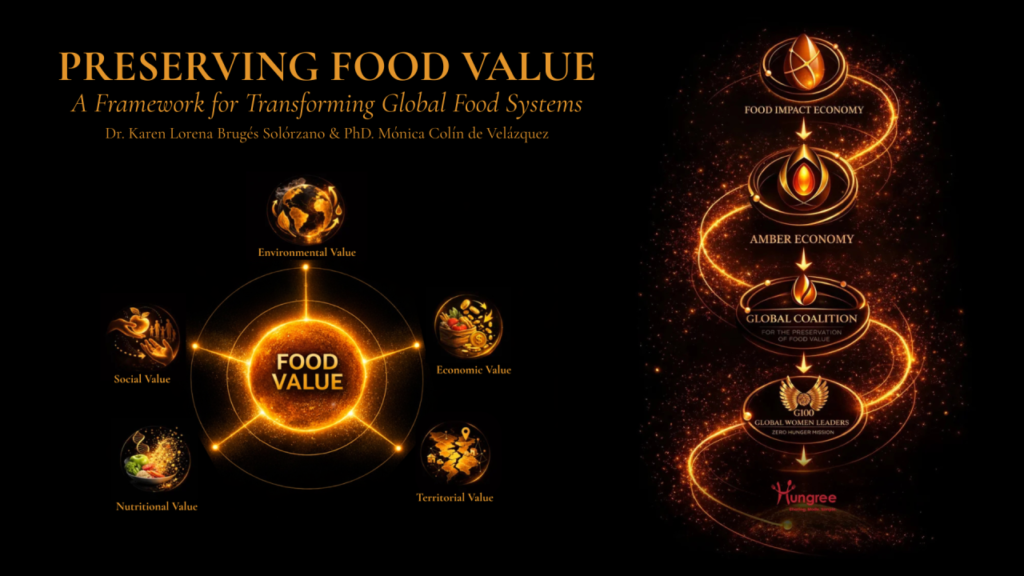
Nutritional value — because food sustains life, health and human development. Economic value — because it represents entire supply chains, investment and livelihoods. Social value — because it connects communities and reduces inequality. Territorial value — because it is rooted in ecosystems and local cultures. Environmental value — because it embodies water, soil, biodiversity and energy.
So when food is lost… we are not losing food.
We are losing value.
That realization is what led us to a different question.
What if food systems were not only designed to produce food… but to preserve the value embedded within it?
This is where Preserving Food Value begins.
This concept has been co-created with Mónica Colín de Velázquez, as part of a broader framework we have been developing: the Food Impact Economy.
It is not just a theory. It is a different way of evaluating and designing food systems.
Not by how much they produce. But by how much value they are able to preserve.
From there, a new economic logic starts to emerge.
What we call the Amber Economy.
An economy where food is no longer treated as a disposable commodity, but as a strategic asset whose value must be preserved, redistributed, recovered and maximized across systems.
This is why this newsletter is changing.
It is no longer only about Zero Hunger.
Because Zero Hunger is the goal. But Preserving Food Value is the system that can actually make it possible.
This space will now focus on that shift.
On how we move from fragmented efforts… to coordinated systems.
On how leadership, policy, technology and collaboration come together to transform how food flows, how value is retained, and how impact is measured.
And also, on how we turn this into action.
Because ideas alone are not enough.
That is why we are moving forward with the Global Coalition for the Preservation of Food Value — a platform designed to connect governments, companies, academia and civil society to work on this at scale.
And this is just the beginning.
On April 28th, we will be launching our book at the Feria Internacional del Libro de Bogotá, where we bring together the vision behind Preserving Food Value and the Amber Economy.
If you have been following my work through Zero Hunger, this is the evolution of that journey.
And if this is your first time here, then you are arriving exactly at the right moment.
Because the conversation is changing.
And how we choose to understand the value of food… will define how we feed the world.
Karen Lorena Brugés Solórzano – Co-Author & Co- Architect Food Impact Economy & Amber Economy | Preserving Food Value | Global Coalition for Preservation Food Value | Global Chair, G100 Zero Hunger Mission | President, WEF California | The HungreeApp
Food is not a commodity. It is a strategic asset.
Building global ecosystems where leadership, technology and collaboration preserve value, strengthen dignity and accelerate the path to Zero Hunger.